
Here at Secret Life of Homesteaders, we believe in keeping things cost-effective. That’s why we always encourage people to grow and regrow food from kitchen scraps.
Regrowing food from kitchen scraps is a great way to save money in the garden. Plus, it’s a surefire way to cut back on waste!
Imagine – instead of throwing away the leftovers from that clump of lettuce, you turned it into an endless supply of fresh, green food!
It doesn’t get much better than that.
And as an added bonus, this method is a great way to introduce kids to gardening. So whether you’re homeschooling your kids (like we are) or you just want to teach your kids some applicable life skills, growing food from kitchen scraps is a fantastic place to start.
This article may contain affiliate links. Please see our disclosure policy for more details.
What Kinds Of Foods (Vegetables, Herbs, etc) Will Regrow?
Because of the nature of vegetables, most will be able to regrow from cuttings or leftover pieces. (On that note, most fruits can be grown from seeds you saved from eating – but that’s for another article.)
Some examples of vegetables and herbs that we have successfully regrown include:
- Big onions (variety doesn’t matter – pick your favorite!)
- Green onions
- Leaf lettuces (any variety of lettuce excluding head lettuces)
- Garlic
- Ginger root
- Carrots (make sure there is some green left on top of the carrot or this won’t work)
- Celery
- Potatoes (any variety including sweet, golden, Russet, etc)
This is not a comprehensive list and there are other foods that you and your kids can easily regrow. These are only the foods we have had personal experience and success with (and have pictures of).
In addition to a variety of food scraps, you will also need:
- Containers and/or pots to put each food item in. We used dollar store containers and plastic cups.
- Small amount of potting soil
- Water
- Warm location with good lighting
Regrowing Your Kitchen Scraps
Before beginning your regrowing kitchen scraps experiment, you will of course need to gather your chosen food items. You can purchase them or use leftovers from scraps you already have.
Encourage each kid to predict which plants will grow back and which will not. This gets them involved in the scientific process.
In order for you kitchen scraps to regrow properly, you will need a warm and well-lit area. We grew ours in the basement where it is colder so we made a makeshift greenhouse for them out of an old fish tank and some plastic wrap.
Preparing and Regrowing Your Food Items

Lettuce
Cut the lettuce leaves about 3 inches from the stem. Submerge in a cup or bowl of water. It is important to only use an inch or less of water; otherwise, the lettuce will rot.
Green Onions
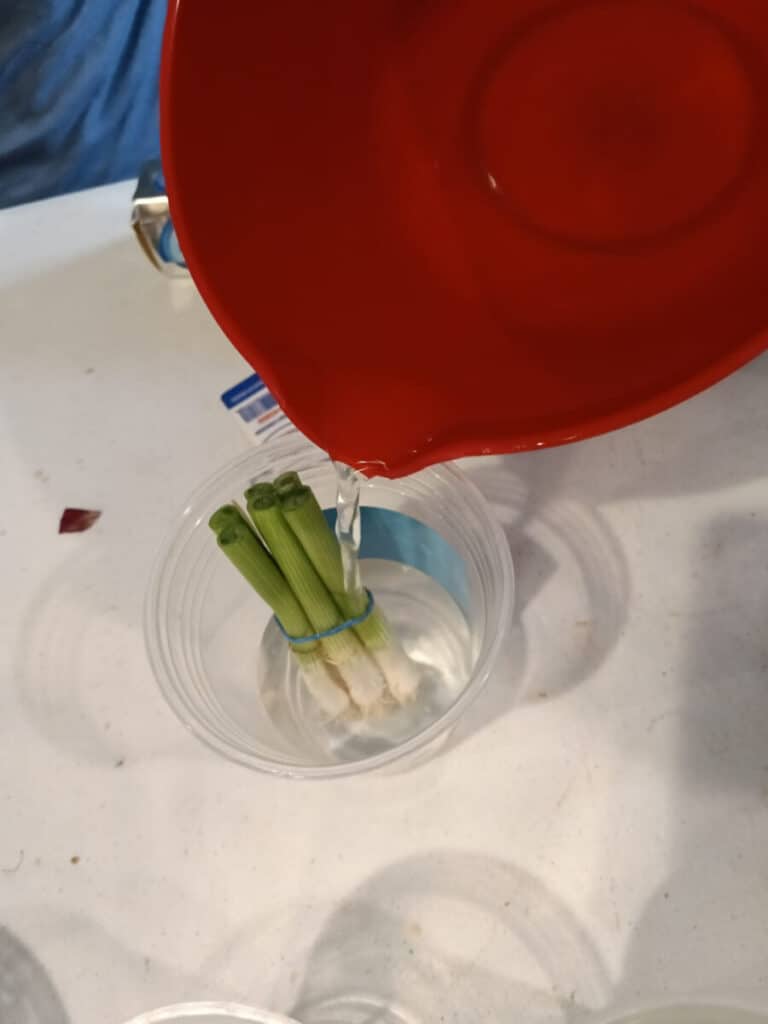
Cut green onions 1.5 inches from the bottom and place them in a cup or bowl of water.
Carrots
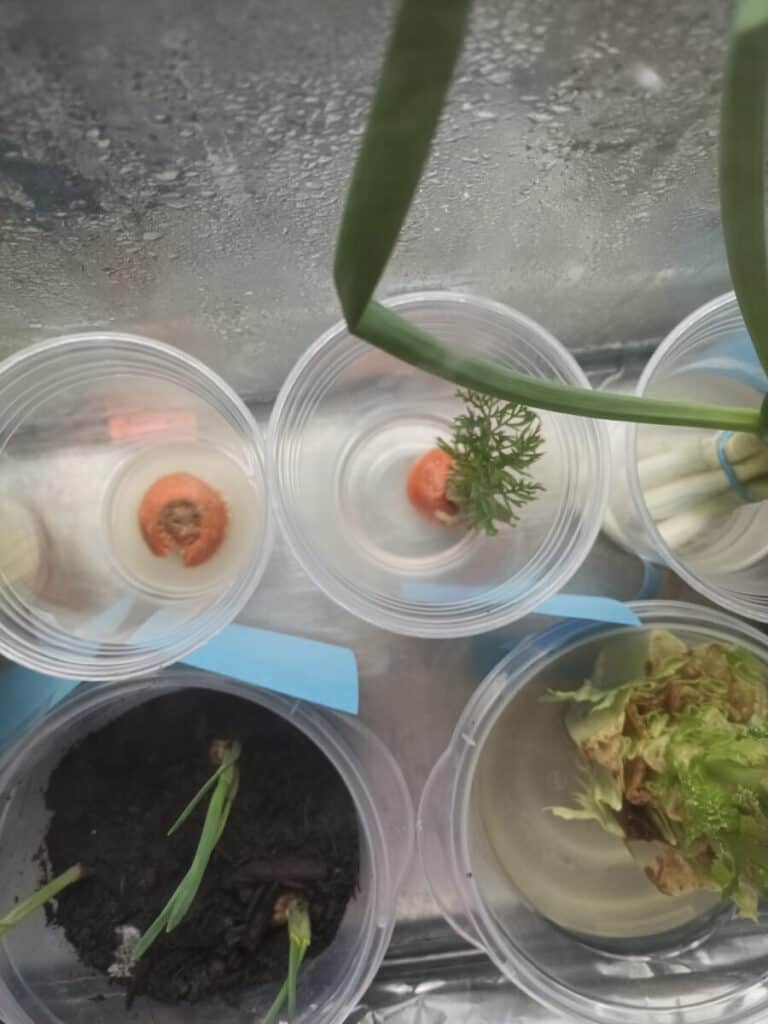
Bear in mind the orange or root part of the carrot will not regrow. However, if you have a carrot that still has some green left on top, the green will regrow healthy and strong.
Carrot greens are delicious and nutritious. Add them to a mixed salad for a snack that is as healthy as the original carrot root.
All you have to do is cut the top off of your carrot about a half an inch from the greens. Then place in a cup or bowl of water.
Onions
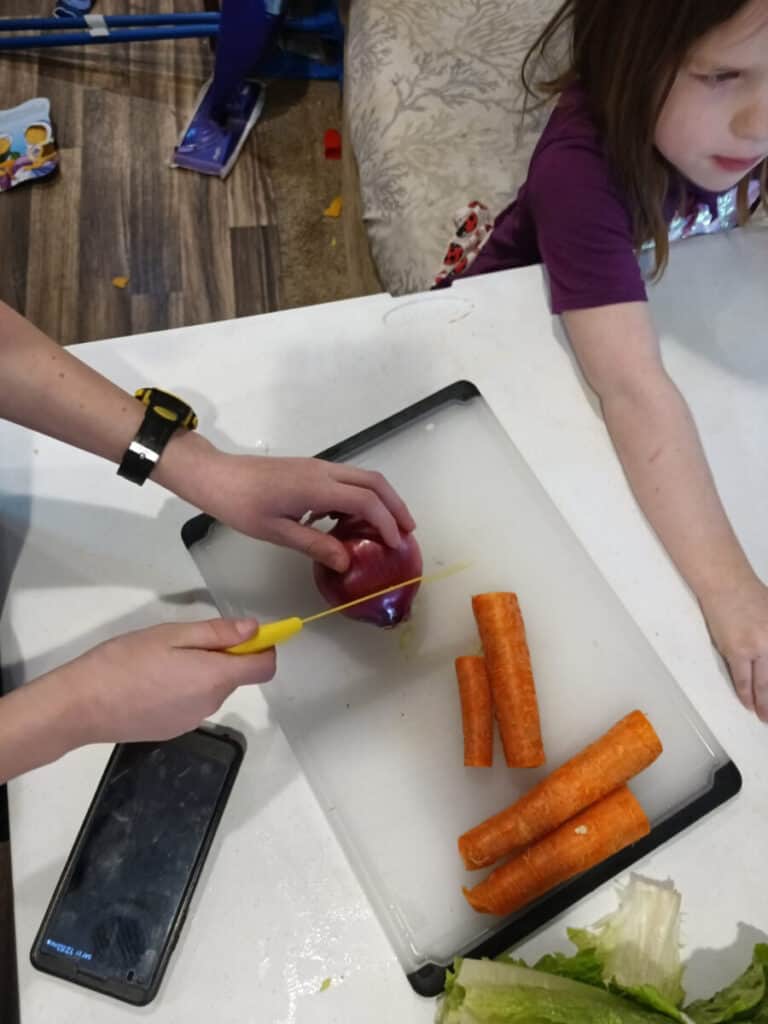
To replant your big onion, cut a large section near the root end. Place this part in potting soil and water it lightly.
Potatoes
Place your potatoes in a darker area. We made a cave for ours out of tin foil. Once the potatoes begin growing ‘eyes’ you can cut the potato into several chunks and plant each chunk in soil individually.
Alternatively, you can just plant the whole potato in soil from the very beginning.
Celery
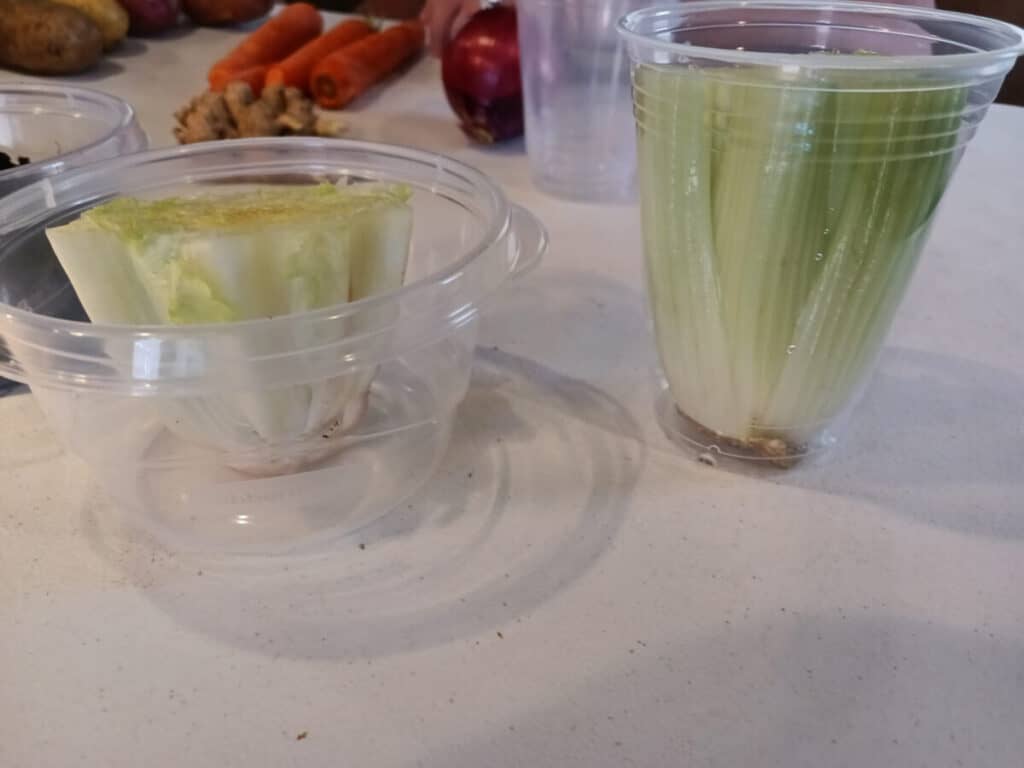
To cut celery, start 2-3 inches from the base and proceed to cut it in a way similar to how you would lettuce. After that, place the celery in water.
Garlic
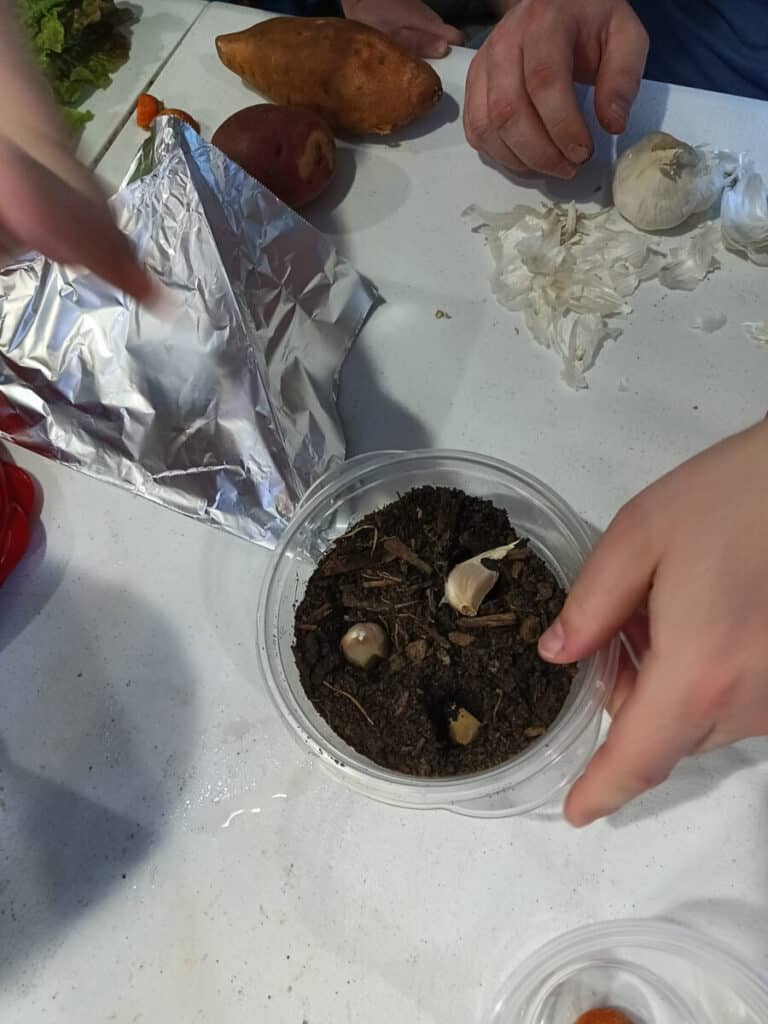
Garlic is easy! Just take one clove of garlic and place it in soil, then water.
Ginger Root
To plant ginger, first cut off a section of the root. then place in soil.
What Happens Next?
No matter what vegetables or herbs you are regrowing, you must allow time to grow and water as needed. You should check your cups and bowls of water regularly to make sure they never dry out, and keep your soil moist but not too wet.
Your cuttings will develop roots in time, and once they do, you can replant them into a sturdier location like your yard or raised garden.
Or if you’re like me and like to keep things like lettuce, green onions, and herbs close to your dinner prep area, go right ahead. This way, it’ll be easy to pluck whatever you need for dinner that night and let the rest continue to grow.
Why Can Food Scraps Regrow Into Food?
Plants reproduce in two different ways. These methods of reproduction include sexual and asexual. For sexual reproduction, a male and a female part are needed in order to make a whole new plant. In asexual reproduction, a new plant grows from parts of the old plant.
Examples of asexual reproduction in plants include:
- Fragmentation – Some plants, such as algae, reproduce by breaking off into two or more fragments that then grow into whole and complete plants. This fragmentation process is why algae can take over a large area in such a short period of time.
- Budding – Some plants, such as Maple Trees and Dogwood Trees, reproduce through budding. Budding occurs when a whole new individual plant. In some species, this process can happen anywhere, and on other species, this only happens on certain parts of the plant.
- Spore formation – Some species, such as ferns, mushrooms, and molds, reproduce by releasing spores into the air. These spores then grow and grow until they are a whole new version of the original plant. Because spores are very light, they can cover great distances in a short period of time.
- Vegetative propagation – Vegetative propagation occurs when new plants are regrown from parts of the original plants such as roots, stems, leaves, and buds. If you have ever seen a gardener talk about growing a tree from a cutting, this is what they were talking about.
Many plants can be grown from cuttings and seeds. A seed is the typical reproduction method of a plant to make a new plant, however, for some plants, if they are cut in the correct place, you can help the cutting regrow roots and become an entirely new plant.
Read Also – Do Seeds Need Light To Germinate?
In this regrowing kitchen scraps project, we will not be making new plants. Instead, we will be allowing the plant to stay alive even after it has already been eaten using the same principle to regrow the roots and then the plant.
Tips and Tricks For Growing And Regrowing Food From Kitchen Scraps
• It was too cold to regrow our plants outside, so we made a temporary greenhouse using an old fish tank and some plastic wrap.
• If you cut the plant too far down, it might be too injured to regrow. It is better to cut off too little than it is to cut off too much. It is okay to be conservative to the plant that you want to regrow.
• Having a warm place is critical for the success of all these plants.
• Don’t put too much water in things like lettuce, celery, onions, etc. They will rot out as quickly as a pot of soil with too much water. You don’t need to cover the whole plant in water, just the very base. So about an inch or two of water is all you need.
• This activity makes for a good excuse to encourage kids to eat vegetables they normally will not eat. My kids, who hate onions and carrots, spent a good ten minutes munching on scraps after we had cut and planted everything.
• Don’t throw away your scraps! Use them to cook or prepare a meal with, to eat plain, or to feed to livestock. Don’t use this activity as an excuse to waste good food.


Charlene has been dabbling in and learning about the homesteading lifestyle for almost 20 years. She recently started a real-world homestead with her extended family and is excited to share 20+ years of knowledge and experience with the world!
While she certainly doesn't know everything about homesteading and is learning more every day, she is excited to learn and grow along with YOU!
Charlene blogs about about homesteading at https://secretlifeofhomesteaders.com/.
Nancy Andres
Friday 20th of October 2023
Pinned this post and am sure going to try regrow more food from kitchen scraps. Saw it at SSPS#283. My shares this week at #26, 27, 28, and 29. Enjoy. Nancy Andres @ Colors 4 Health
Helen at the Lazy Gastronome
Sunday 27th of August 2023
I'm running behind!! Thanks for sharing at the what's for dinner party last week - The new party is open now. Hope to see you there!
Paula
Thursday 24th of August 2023
Charlene, wow! I had no idea. I'm so happy I found you. Visiting today from SSPS 275 #87
Esme Slabbert
Wednesday 23rd of August 2023
Waste not want not - love all the veggies and will try my best to regrow some for own use. Thank you for sharing your links with us at #275 SSPS Linky. See you again next week.
Michele Graham
Sunday 26th of March 2023
Hi Charlene. Thanks for posting at Funtastic Friday . I like all the tips. I had tried the green onion trick and recently we id the romaine lettuce. It was amazing. Pinning.